
A note from the founder
Finding Common Ground
A landmark Princeton & Northwestern analysis found that ordinary Americans have “near-zero” influence on federal policy when their views diverge from elites. And despite broad agreement across party lines on many specific federal policies, Congress doesn’t act. Common-Ground.US exists to make that agreement visible — and to build the collective voice to act on it. ~10 min read.
There’s a feeling a lot of us have been carrying — that our government isn’t reflecting what most Americans actually want.
It turns out that feeling is well-founded. It’s a documented fact in political science.
Professors at Princeton & Northwestern analyzed 1,779 policy issues over two decades. Their finding: when ordinary citizens’ preferences diverge from those of economic elites and organized interest groups,
“the preferences of the average American appear to have only a minuscule, near-zero, statistically non-significant impact upon public policy.”
This is the structural failure of our democratic system. I don’t think I’m alone in asking if we can do something about it.
The mission: Making Government Accountable to the Will of the People
The commercial news media and political consultants tell us that our government is paralyzed because the American populace is hopelessly divided.
But the empirical data completely invalidates that narrative.
When we step past the cultural silos – both manufactured and real – and focus on actual, concrete federal policies, there is widespread agreement. It is just being systematically drowned out and splintered.
The University of Maryland’s Program for Public Consultation — highly respected and widely cited by academics — has spent two decades documenting this common ground. Their method — briefing participants on each policy’s verified pros and cons before asking their view — cuts past the reactive noise of standard polling.
PPC research documents 88 distinct federal policies with over two-thirds supermajority support among both Republican and Democrat voters. Yet, virtually none of them are moving through Congress.
For example, universal background checks for gun purchases – banning congressional stock trading – allowing the government to negotiate drug prices like other countries do – establishing a clear code of ethics for the Supreme Court … The list is long.
The Perception Gap
Democrats assume a minority of Republicans favor stronger gun safety regulations — actually two-thirds do. Republicans assume a majority of Democrats want open borders — actually only a third do.
This means the person you thought you’d never agree with is actually closer to your ground than either of you has been told. The other side you’ve been trained to fear is, in significant measure, standing right next to you.
Of course, there are important flashpoints of disagreement that are very difficult to resolve. But where there is verified two-thirds popular support in both parties, it’s reasonable for the governed to expect enactment of those choices.
When it doesn’t happen, it forces the question: “why not?” And “how do we fix it?”
Just Powers from the Consent of the Governed
What happens when the government consistently deviates from the documented will of the people? Trust falls. We are currently near the lowest levels of trust in government ever recorded.
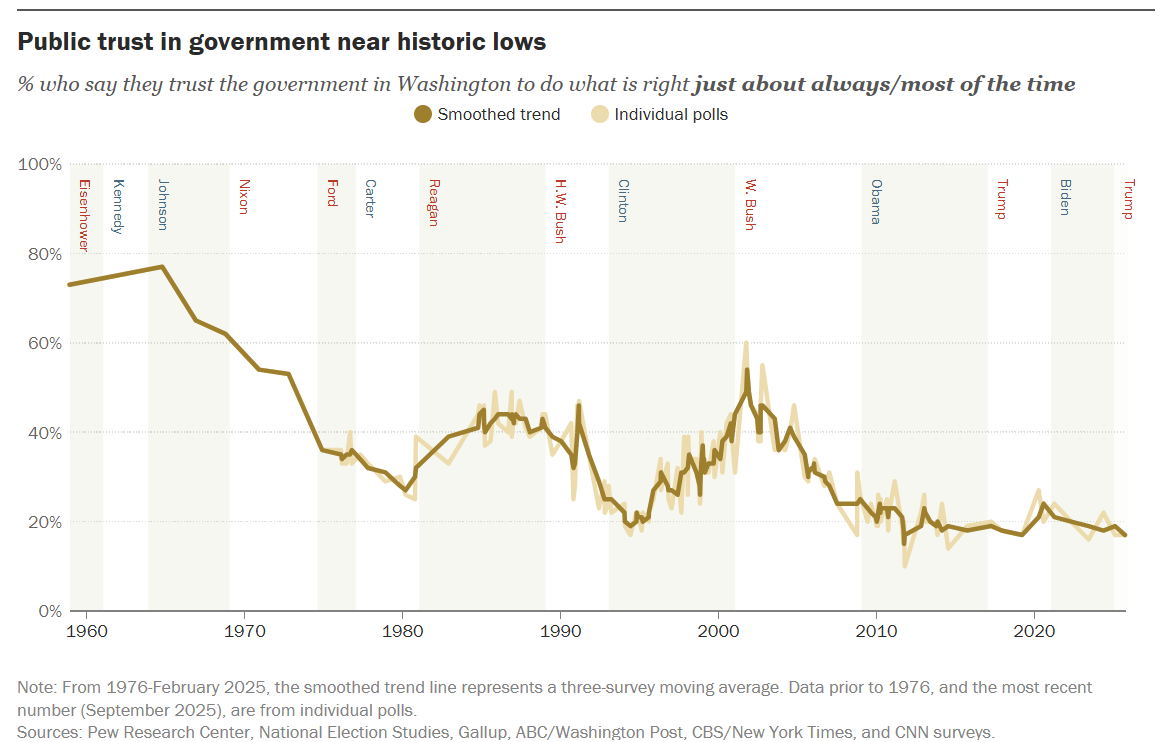
Fortunately, there is a clear constitutional remedy – because authority is located in the People. However, as the respected political theorist Hannah Arendt observed, individual citizens holding private opinions do not possess political power.
“Power corresponds to the human ability not just to act but to act in concert. Power is never the property of an individual; it belongs to a group and remains in existence only so long as the group keeps together.”
Widespread private agreement coordinates nothing. A million isolated voices holding the same belief hold zero political currency in a system dominated by concentrated money. True democratic power requires a mechanism to turn a hidden, dispersed majority into an organized, collective reality.
Our Common Ground
Common-Ground.US exists to make Americans’ agreement so visible that it is impossible to ignore – that’s Goal #1. This website provides a clean, non-advocacy look-up tool, making it simple for anyone to explore the extensive policies backed by bipartisan-supermajority support. We don’t author the research — that’s done by leading academic institutions and top polling specialists like Pew Research, Gallup and KFF.
The Common Ground Platform is the set of these bipartisan-supermajority policies, organized into 9 planks, each representing a clear domain of public will – that if enacted would move our government in a very positive direction. These planks cover Government Performance, Too Much Money in Politics, and Healthcare, to name just a few. The Platform will evolve over time, but the operational criteria will remain the same: the policy must have supermajority support in both parties, and it must fully respect individual constitutional rights.
Acting in Concert
Our approach is based on Arendt’s observation that the People must act in concert if they want to assert their political power. Common Ground’s Goal #2 is to provide a rallying point for the People – giving people a way to act on it together – through two integrated mechanisms:
- The Platform: An objective, public standard showcasing the planks and policies that we can all point to, representing what we agree on.
- The Declaration: A public statement connecting like-minded citizens, so we can act in concert.
Citizens can express their alignment with the foundation of our democracy – A Government That’s Accountable to the Will of the People – by signing the Common Ground Declaration in support of this principle and the resulting Platform.
Why sign the Declaration?The public act of standing up is essential: without mutual awareness of one another, there can be no acting in concert. Your signature won’t expose your full street address like a standard petition; it simply adds your name and state to a permanent public record. Unlike typical political battles, there is no opposing side – who can argue that a two-thirds bipartisan consensus isn’t worth pursuing?
What am I asking of you? This is not an invitation to blindly sign a statement. I simply ask that you take a few minutes to look over the Platform and the Declaration. If it aligns with your principles, stand up, sign your name, and let yourself be counted.
If it doesn’t resonate, I’d be very grateful if you reached out to tell me why. If you’re skeptical, bring that skepticism — your perspective will help us build something better.
The Common Ground Declaration
I support the Common Ground principle: that when supermajorities across party lines agree on policies that respect individual constitutional rights, Government should act on those policies.
The Common Ground Platform — 9 planks meeting those criteria today — is the principle in action; the Platform will evolve as agreement shifts and as planks become law. When each Platform version is published, I ask my Representative and Senators to act on it, or to explain why their view is different.
I know not every plank will be my preference. I value action on documented common ground.
This Declaration complements — it does not preclude — advocacy for causes without such consensus. Many essential expansions of civic and constitutional protection came through minority advocacy against majority opinion. That work remains vital.
The founders called this — this kind of government at the consent of the governed — the American experiment. It’s still an experiment. Two hundred and fifty years in, it survives when Americans keep implementing it. Generation after generation. Not by heroic acts, but by the ordinary decision to stand publicly on what we actually share, and to let ourselves be seen doing it.
That’s the offer. Not to join a movement. Simply to be counted for what you already believe.
If any of this resonates, you can show your support and sign here:
Stand Up and Be CountedEither way, I’d value your reactions — supportive, skeptical, or somewhere in between. And if you know friends or family thinking about these same things, please do forward this along.
Heartfelt thanks,
Keith Lietzke